


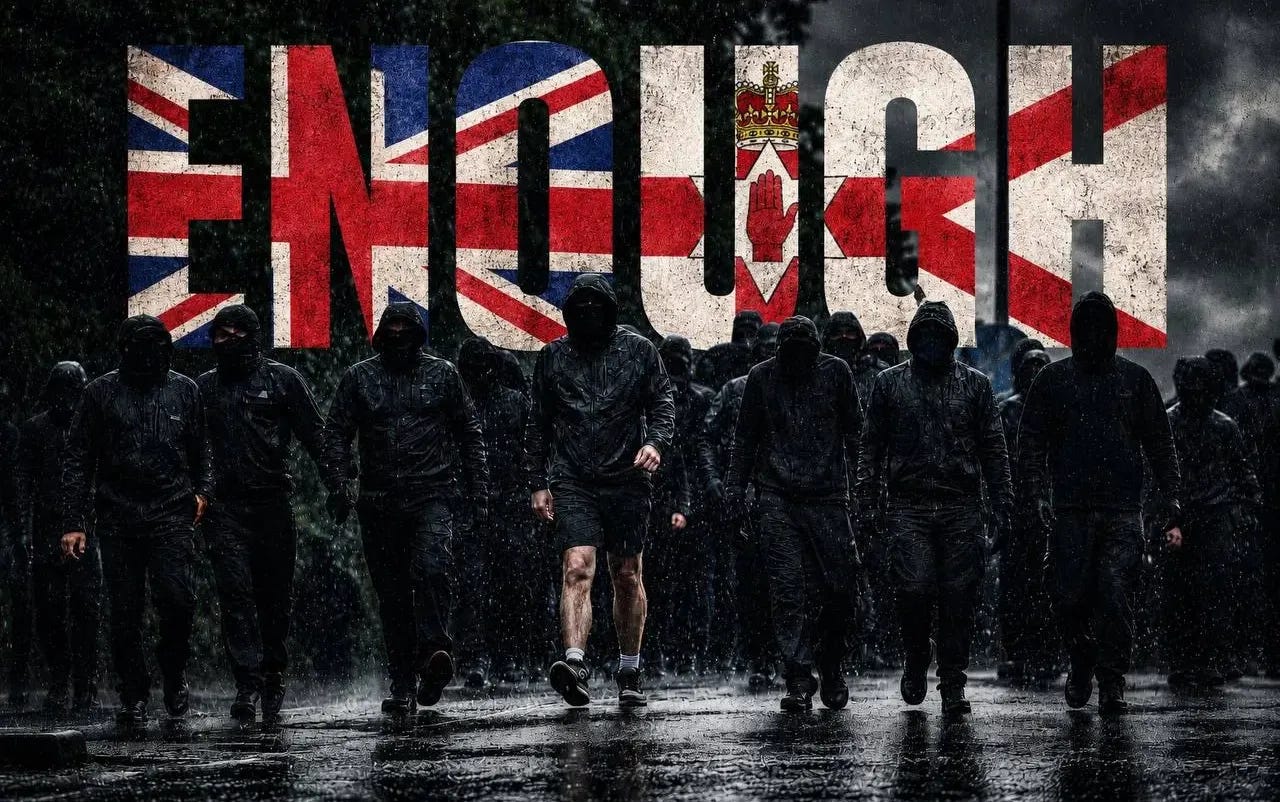
Now some six weeks on from the riots which tore through both Belfast and social media’s broader ethnonationalist ecosystem—riots precipitated, the reader need not be reminded, by an attempted beheading at the hands of a Sudanese refugee—the burned-out cars and heat-warped wheelie bins have been cleared from the Newtownards Road. So too has the anti-Islam graffiti been scrubbed from foreign-owned storefronts along Sandy Row, the windows of formerly immigrant-occupied housing on McMaster Street quietly replaced, the city returning, at least ostensibly, to the uneasy calm which has defined it for the best part of thirty years.
Beneath these refurbishments, however, the embers of a new resentment continue to smolder. For three days in early June, bands of black-clad young men, reportedly two-hundred-strong, surged through the Northern Irish capital with quasi-militaristic efficiency, their progress aided by more impromptu crowds who kept police at bay behind a barrage of bricks, bottles and some customary “Belfast confetti,” i.e. petrol bombs. Working from a pre-circulated list of addresses, they advanced methodically, tearing down fences, kicking in doors and instructing any non-native they found to summarily vacate. Asylum hotels were likewise besieged, as were kebab shops, Turkish barbers and halal butchers, while elsewhere, balaclavaed patrolmen erected roadside checkpoints in scenes eerily reminiscent, in form if not in function, of the darkest days of the Troubles.
In the aftermath of this disorder, the political establishment (alongside their dutiful media mouthpieces) responded with a familiar mix of teleprompted condemnation and patently performative bewilderment. How could this happen? How did such racist thuggery descend upon the streets of Belfast? If any of them mentioned the incident which ignited the powder keg, it was only ever in passing, scarcely more than a handful daring to acknowledge, let alone interrogate, the wilfully imported crime wave that had ultimately laid the kindling.
Yet, for all their promises of thorough investigations and pledges to leave no stone unturned, one question remained conspicuously absent from their post-mortem.
Did the riots work?
On a purely demographic level, specifically the participants’ stated objective of “getting the foreigners out,” this is all but impossible to quantify. In the days following the upheaval, a Facebook post circulated by “Our Northern Ireland Voice – Protecting Our Culture from Foreign Infidels” asserted that over 400 immigrant families had left the country as a direct result of the violence. This claim was, by all available evidence, wholly unsubstantiated, with a network of allegedly independent analysts offering far more conservative figures. According to FactCheckNI (whose funding is derived from the likes of Meta and the European Commission), by the evening of June 15th, less than a week after the unrest began, 86 households had contacted the Northern Ireland Housing Executive, almost a third requesting temporary accommodation. Meanwhile, self-styled “community groups” estimated that around 200 people, local and non-local alike, had been forced from their homes, with anecdotal reports suggesting that many among the latter had been diverted, not back to their countries of origin, but onward to Derry, Newry, or even “across the water,” to English or Scottish cities with lower profiles and, crucially, lower temperatures.
How much stock one puts in these numbers is another matter entirely. After all, it would seem naive to assume that any government or government-affiliated agency would broadcast a significant exodus for fear of inspiring copycat vigilantism, just as more militantly-minded anti-immigrant voices might be tempted to inflate them in the hopes of establishing a replicable precedent.
Of course, it might easily be argued—and indeed, already has been among much of the right-wing commentariat—that such a precedent was set long before the first Molotov was thrown in Belfast. Just last year, in response to the purported rape of a local girl in Ballymena, rioters succeeded in expelling two-thirds of the town’s Roma population in what was then one of the most decisive examples of mob-driven displacement in recent British history. Tempting though the comparison may be, it remains an imperfect analogy for what unfolded this summer. The Roma’s deep-rooted nomadic traditions make their flight from Ballymena a vastly more predictable reaction than any hypothetical recurrence in Belfast, particularly when you consider the lavish benefits these so-called “asylum seekers” receive, as well as Home Office protocols that effectively bind them to assigned addresses while their applications are being processed.
But while most of those cheerleading Ulster’s unofficial remigration enforcement have by now accepted that no Ballymena-scale purge will this time be forthcoming, many are optimistic that the events of June may yet act as a potent deterrent, not just to future arrivals, but also to the landlords who profit from the racket. This would undoubtedly constitute a substantial victory. Statistics cited by The Telegraph show that well over 50,000 migrants entered Northern Ireland between 2021 and 2024, representing an almost fivefold net increase from a decade prior. These figures might appear modest by the standards of France, Germany or virtually every other Western European nation, but with a population still shy of 2 million, demographic change registers much more acutely in this tiny, troubled corner of the United Kingdom, its foreign-born population (concentrated overwhelmingly in Belfast) having grown at almost four times the rate of England and Wales.
Even these figures tell barely half the story. Earlier waves of immigration emanated principally from Eastern Europe, an influx which brought with it a host of societal frictions yet which nonetheless shared, however imperfectly, a broadly comprehensible set of moral and cultural standards. The ongoing onslaught has been of an altogether different character. Drawn predominantly from the Middle East and sub-Saharan Africa, the minorities targeted in Belfast are products, not merely of radically alien civilisational frameworks and irreconcilable religious orthodoxies, but also—as so many have been conditioned to overlook—fundamentally incompatible racial dispositions.
This alone may ensure that whatever disincentive the Belfast “pogroms” engendered will inevitably prove fleeting. Certainly, the places these would-be immigrants are seeking to escape are often so fractured and so dysfunctional, so utterly bereft of any pursuable future, that three days of burning buses and shuttered shopfronts scarcely registers against the wretchedness they are right now enduring. Moreover, the most rigorous attempts to catalogue post-riot departures discovered that most of these were EU citizens, indicating that even amid an atmosphere of all-pervasive hostility, Belfast stands, by any meaningful metric, infinitely preferable to the Taliban-controlled slums of Kabul or the cholera-plagued squalor of Mogadishu.
Regardless of either its short or long-term impact, what remains beyond question is that the disorder will do nothing whatsoever to derail the government’s commitment to the demographic erasure of Britishness. With the city still ablaze, then-Prime Minister Keir Starmer appeared before the cameras, as he had so many times before, to denounce the violence as “completely unacceptable,” warning that “those responsible will feel the full force of the law.” His sole concession was a proposed crackdown on illegal immigration, all while pointedly refusing to address any of the legal mechanisms which comprise the core of the problem. Stormont’s response was every bit as substanceless, its various parties competing to distance themselves from the protests and, by extension, from the very people they nominally represent—their fingers thrust accusingly at a nebulous cast of “online agitators,” “far-right extremists” and “a small minority of racists who do not speak for the decent, tolerant, multicultural community of Belfast.”
This community duly materialised. Outside City Hall, thousands converged for a “Together Against Hate” rally, few of its disproportionately young, disproportionately female, and disproportionately middle-class attendees ever having been forced to share a bus route with the diversity they had gathered to celebrate. It was a crowd outwardly indistinguishable from any other anti-racist demonstration, yet beneath its surface pulsed a particular strain of Northern Irish leftism that is at once keenly aware of and chronically embarrassed by what they regard as their society’s outdated tribalism, its enduring insularity, but above all, its stubborn resistance to the “progress” that prevails throughout London and Dublin.
Still, no matter how many purple-haired lesbians the cameras panned to, or how many of Belfast’s most photogenic foreigners journalists interviewed, their cosmopolitan convictions could not be projected onto the city as a whole. A survey conducted by More in Common—a self-consciously “centrist” polling organisation whose avowed raison d’être is the promotion of social cohesion—found that while a large majority condemned assaults on police officers or setting fire to non-natives’ homes, the anxieties expressed over those fateful few days were anything but marginal. Neither were they cut along the age-old fault lines of green vs orange. Immigration now sits in every community’s top three concerns, with 63 percent of unionists ranking it their single biggest issue. More striking still, almost half of nationalists said they would support checks along the border with the Republic of Ireland even if it meant entrenching a partition their political and, in no small measure, their existential identity was built on dismantling. Perhaps most remarkable of all, however, was that almost 1 in 4 respondents felt that this “small minority of racists” did in fact speak for them, a finding starkly at odds with Stormont’s pearl-clutching consensus.
Not that these cross-community sentiments were materially reflected in the composition of the rioters. Although nativist commentators outside Northern Ireland have been eager to portray the unrest as some kind of post-sectarian endeavour—two old enemies setting aside their animosities in the face of a common threat—what this amounts to, in essence, is the right-wing equivalent of a race-swapping Netflix adaptation. True, there were isolated pockets of republican participation, most notably by small groups from the militant enclaves of Short Strand and Ardoyne, but by and large, the violence was an unambiguously loyalist affair, a feature which has enabled the political and media classes to conceptually quarantine anti-immigrant grievances within this much-maligned constituency.
That is not to say the Republican reaction to the riots (or rather, their non-reaction) was in any way trivial. In decades past, even the faintest hint of loyalist chest-thumping would have been enough to provoke a reflexive counter-mobilisation from the tricoloured side of Belfast, the annual 12th of July celebrations serving as the most reliable case in point. This time, no such mobilisation transpired, a passivity which itself spoke volumes. Whereas loyalist opposition to demographic shifts has long been instinctive, their Catholic counterparts have often aligned themselves with arrivals from the post-colonial world, seeing in their perceived persecution echoes of their own historical experience.
Up close, this solidarity has rapidly curdled. This may be most immediately apparent in Republicanism’s growing disillusionment with the Third-Worldism which has so thoroughly permeated the movement, although yet more seismic still, as the cultural enrichment body count continues to mount, is the reckoning which could await those who injected it: Sinn Féin.
Having built their electoral dominance on the rhetoric of “Ireland for the Irish,” once in government the party revealed itself to be as enthusiastically committed to the same open-borders, diversity-first dogma as every other appendage of the neoliberal world order. Even their long-feared paramilitary wing, the IRA, has emerged as an enforcer of this very same agenda, many of its higher-ups having been instrumental in discouraging working-class Catholic youths, presumably with much more than strong words and a fatherly arm round the shoulder, from joining the riots. But this capitulation goes beyond the purely political. Kneecap—the Belfast hip-hop act which has adeptly marketed their insurrectionary aesthetics to an audience of pride flag-waving festival-goers—embody the cultural component of this transition most explicitly, encapsulating Republicanism’s drift from the hardline nationalism of the Troubles to today’s post-ceasefire progressivism.
Though intensely localised, the events of June may ensure that these seemingly parochial politics have implications far beyond the borders of Northern Ireland. The Belfast riots, it goes without saying, came hot on the heels of other anti-immigration flare-ups in Epping, Rotherham, Southport and Southampton, as well as a litany of other European cities benighted by foreign savagery. In their respective ways, these earlier episodes had already illustrated the limits of all available models of dissent. Peaceful protest, however large and however sustained, had been categorically without consequence while disorganised violence had proved worse than useless, granting legal ammunition to the state while delivering participants into the hands of a ruthless and ideologically captured judiciary.
What Belfast provided, by contrast, was a third model. Two hundred loyalists, uniformly masked and rigidly disciplined, did not seek redress through parliamentary petitions or impotent pleas for the safety of their children. Nor did they descend into directionless, impulsive destruction, feebly appealing for sympathy as they were stomped beneath the heel of the riot squad’s boot.
Instead, they took matters into their own hands. The police, deployed in numbers that would have been sufficient to contain comparable crowds elsewhere, found themselves outmanoeuvred by a community shaped by generations’ worth of conflict and long ago stripped of any prospect of political change. For those English and Scottish protestors who had gone before, quite possibly watching on from a prison cell, the conclusion was difficult to ignore: that what separates a movement the state can process from one it cannot lies less in the intensity of its anger and more in the ruthlessness of its execution.
As such, wherever the next instance of immigrant-inflicted atrocity occurs, whether it be a terrorist attack in Birmingham, a political assassination in Paris or a gang rape streamed in harrowing HD from Stockholm, few will be surprised if the native response resembles tactics employed by the loyalists of Ulster. Admittedly, these places may not possess the same operational know-how or the same paramilitary infrastructure, but similarly silenced and equally stripped of any electoral outlet, the indigenous people of Europe as well as their Anglosphere cousins may soon find themselves with little option but to follow the blueprint first laid down in the fire-scarred streets of Belfast.
Thanks ever so much for reading. Given that you’ve made it this far, please consider giving this article a like, share, or better yet, a comment—I really can’t tell you how much that helps. If, on the other hand, you’d like to support my work (and are in a position to do so), I would be indescribably grateful if you might consider becoming a paid subscriber, while alternatively, you can always send a one-time donation via the link below. As I’m sure you can appreciate, piecing together essays of this scope necessitates a substantial amount of time and effort, and every contribution goes a long way in helping me produce others like it.
Thanks again for your time,
Carson

Some Recent Articles You Might Like:
On Substack, Selfhood, and the Fleeting Fiction Called "I"

One of the most famous and most oft-invoked dictums in all of philosophy is the Socratic claim, allegedly uttered at his trial for corrupting Athenian youth, that the unexamined life is not worth living. This would seem difficult to dispute, not least on a platform as innately navel-gazing as Substack...
Bruce Springsteen: The Poet Laureate of Boomer Pathology

In a year already rich with tragedies—from the bombing of 120 Iranian schoolgirls to the systematic memory-holing of Iryna Zarutska, from Europe’s epidemic of migrant-inflicted savagery to the state-sanctioned murder of Noelia Castillo—Bruce Springsteen’s performance at the recent No Kings rally in...
On Mental Illness and the Therapeutic Erasure of Evil

“The older I get,” wrote Dudley Newright recently, his note accompanied by the video above, “the more convinced I am that the line between ‘mental illness’ and ‘evil’ is blurry and, in some (not all) cases, ‘mental illness’ is simply what happens when a person who wants to ‘be bad’ gives themself fully over to the urge to be...