


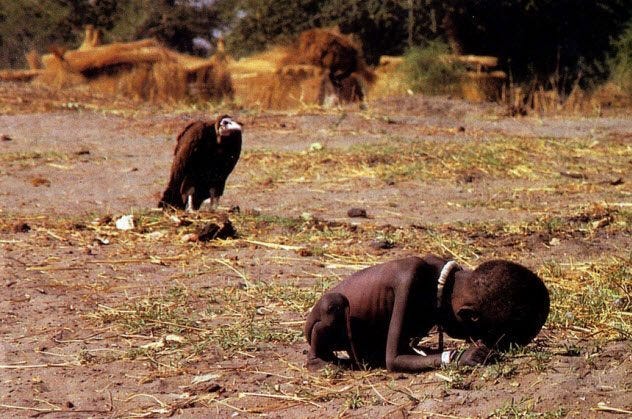
It is, without question, one of the most iconic and most immediately impactful photographs ever taken. First published by the New York Times on March 26th, 1993, almost a decade into Sudan’s famine-ravaged second civil war, “The Vulture and the Little Girl,” as the image became known, provoked a virtually unprecedented outpouring of grief and moral indignation which, even in our age of livestreamed genocides and high-definition drone strikes, has seldom been replicated since.
It would take an unusually hardened heart to wonder why.
Depicting what was thought to be an unnamed female toddler, skeletal and presumably doomed, the picture seemed to compress the Africa of Western consciousness into a single frame—the vulture an unhurried incarnation of the vast, unappeasable death said to stalk the continent. It was a story legible at a glance, and yet, however unflinchingly the photograph exposed the suffering of its subject and, by extension, the hunger and helplessness of Sudan, what it concealed (and ultimately, what it compounded) was the still more senseless tragedy of the man behind the camera.
His name was Kevin Carter, a thirty-two-year-old South African photojournalist who had risen to prominence during the dying days of apartheid for his work documenting the brutality of the country’s township wars. Born in Johannesburg to liberal Catholic parents, he had spent his childhood watching police haul Black residents from his Whites-only suburban neighborhood—injustices, as he saw them, which would form the foundations of his lifelong anti-segregationist convictions. After a string of abandoned starts, including a military stint that earned him a beating for defending a Black mess-hall worker, he eventually found a more purposeful outlet for these convictions in the aftermath of Pretoria’s 1983 Church Street bombing, the once directionless young idealist resolving to turn his lens on South Africa’s endemic and rapidly escalating violence. He soon made a name for himself, initially by shooting weekend sports for the Sunday Express and then as a frontline news photographer at the Johannesburg Star, becoming the first to capture a so-called “necklacing” (alleged collaborators immolated inside gasoline-soaked tires), in addition to chronicling the procession of hostel massacres, machete battles, and near-daily street executions that the National Party government at once sought to exacerbate and obscure.
By the time he was invited to fly to Sudan, Carter had already witnessed more bloodshed than most soldiers. His assignment was intended to generate publicity for both the ongoing famine and the UN’s humanitarian efforts; however, by his own admission, his reasons for accepting were not solely altruistic. Beset by financial troubles, a spiraling drug habit, and the psychological burnout all but inseparable from his chosen career, Carter had come to believe, rather optimistically, that the corpse-strewn countryside of Sudan would offer a “change of scenery” as well as a temporary reprieve from the reciprocal, hand-to-hand butchery he’d been covering in Johannesburg.
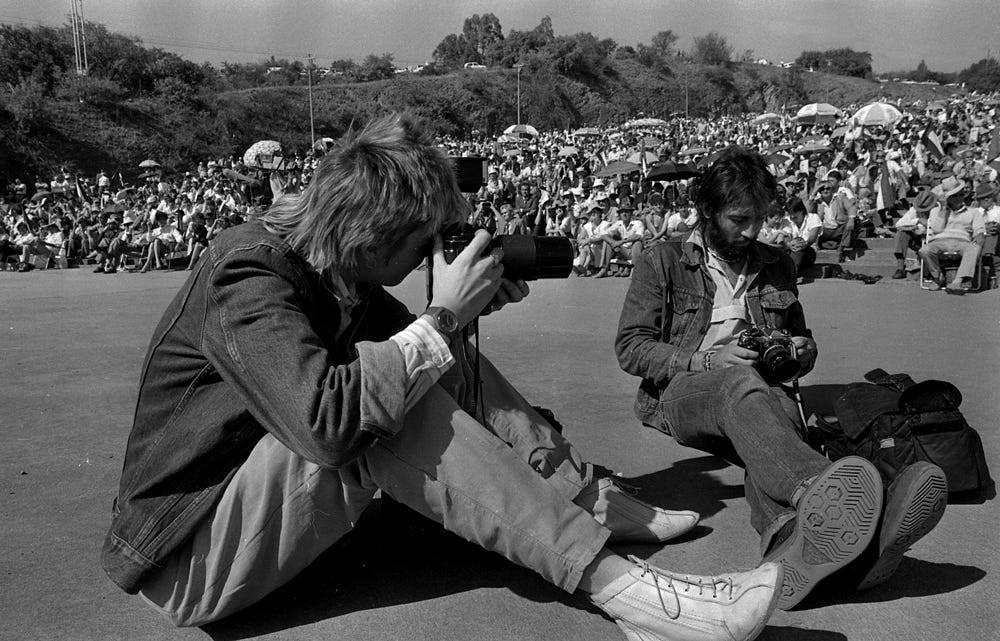
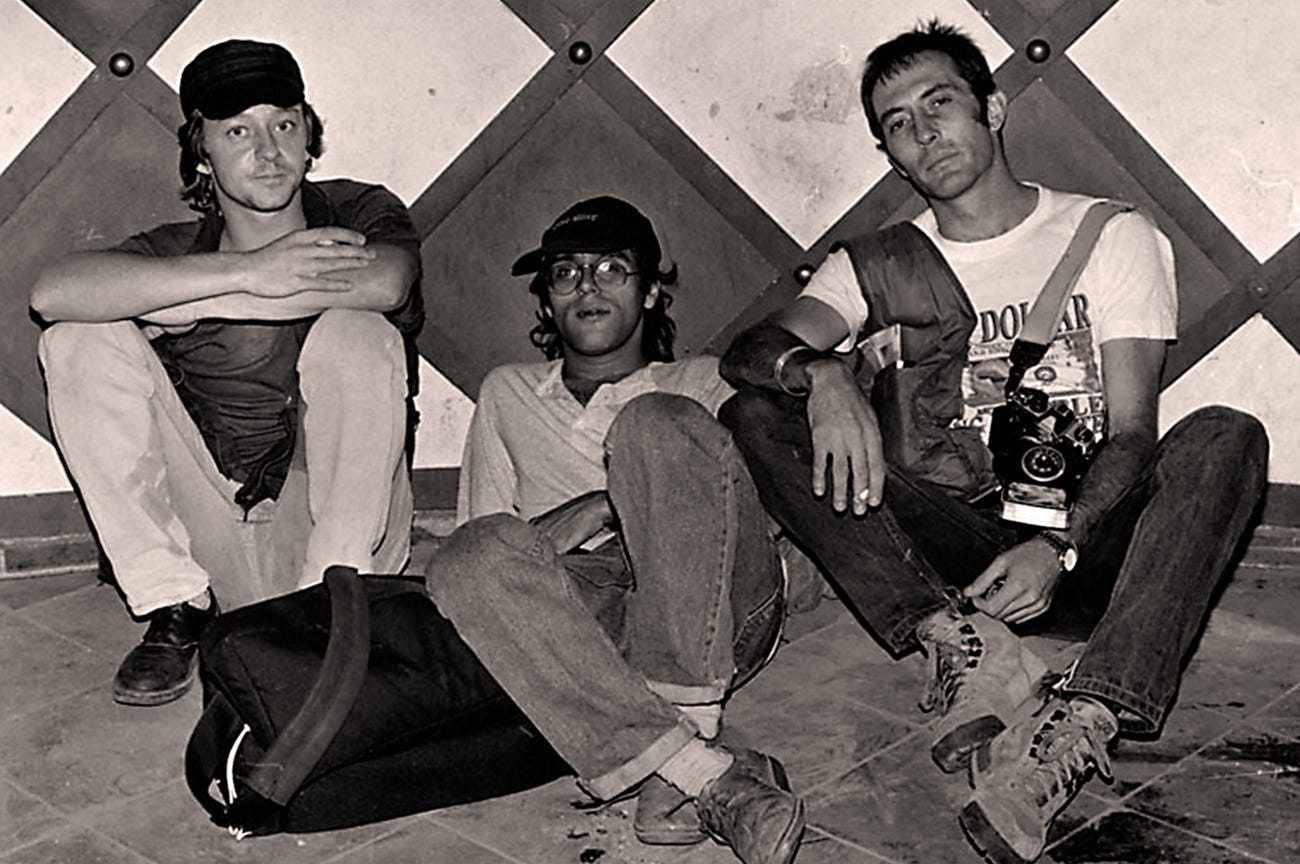
But beneath this ran a still weightier motive: professional envy. Alongside Greg Marinovich, João Silva, and Ken Oosterbroek, Carter belonged to a fiercely ambitious, infamously adventurous, and improbably close-knit quartet of photographers known as the Bang-Bang Club. Internal rivalries were intense. Two years earlier, Marinovich had won a Pulitzer for his shots of a suspected informer being burned alive by a Soweto mob, while Oosterbroek, now steadily ascending the ranks at the Star, was enjoying the kind of professional success rarely afforded atrocity photographers. Carter, himself the most experienced member of the group, was beginning to feel visibly eclipsed by his peers, an estrangement which only fueled his pursuit of “the one great picture” that would cement his own global legacy.
This arrived in the village of Ayod on the northwestern tip of Sudan’s notorious “Hunger Triangle.” While his partner Silva went in search of rebel soldiers to profile, Carter remained at the feeding center snapping portraits of the wraithlike ration-lines, but soon became so overwhelmed by the scale of misery that he was forced to step outside. It was here he came across the starving child. This scene, for all its visceral bleakness, was far from unique; Carter had photographed little else since landing and besides, there were quite literally hundreds of similarly cadaverous bodies scattered in every direction.
That was until the vulture landed. For a full twenty minutes, Carter crouched in silence, careful not to startle the bird, hoping that it might spread its wings and thus complete the composition. It declined to do so, but he took his photograph regardless and two weeks later, beneath a headline that read “Sudan Is Described as Trying to Placate the West,” the image was thrust before a worldwide audience.
Not even Carter, who’d instantly recognized the power of what he had just recorded, could have predicted the reaction that followed. Most tangibly, this manifested as a surge in public attention on Sudan, with millions of dollars donated to the famine relief effort. But concerns quickly narrowed. Letters demanding to know what had become of the stricken child poured into the Times in such numbers that editors felt compelled to offer a response. It read:
“A picture last Friday with an article about the Sudan showed a little Sudanese girl who had collapsed from hunger on the trail to a feeding center in Ayod. A vulture lurked behind her. Many readers have asked about the fate of the girl. The photographer reports that she recovered enough to resume her trek after the vulture was chased away. It is not known whether she reached the center.”
The note, unsigned and briskly procedural, said nothing of the war. It certainly said nothing of how, after chasing the scavenger away, Carter had sat under a tree and wept, praying through anguished puffs on his cigarette as he thought of his own daughter, Megan.
It is doubtful whether this would have mitigated any of the backlash. By now, critics had begun asking altogether more pointed questions: why hadn’t the photographer helped? Why hadn’t he picked the girl up and carried her to the feeding center? What kind of man (if such a charitable epithet was even employed) goes about his work while a child perishes at his feet? The St. Petersburg Times went so far as to denounce Carter as “a predator, another vulture on the scene”—a characterization which, amplified through the feedback loop of obliging press and aggrieved readership, swiftly metastasized into an industry-wide ethical debate, into something approximating a journalistic moral fable.
But while this fable now had its villain, what remained absent from either the outrage directed toward Carter or the sympathy reserved for the victim of his supposed indifference was any mention of those who had actually engineered her plight. After all, by the time the photograph was taken, Sudan had spent 26 years of its 37-year independence locked in pitiless civil war, the second iteration of which saw the country's Islamist government pitted against the Sudan People's Liberation Army, a Marxist-Leninist insurgency operating out of the predominantly Christian, secession-inclined south.
The famine was not an unfortunate byproduct of this conflict, but one of the primary vehicles through which it was fought. Rather than engaging the rebels village by village, Khartoum-led militias were ordered to sabotage the enemy's grain belt—seizing cattle, burning stores, driving farmers off their land—so that when drought arrived, as it so often does in this perennially parched corner of Africa, the south found itself stripped of every reserve which might have sustained it. The SPLA responded in kind, attacking government convoys and blockading supply routes into garrison towns, but when the group split in 1991, succumbing to ethnic, ideological and personal infighting, these tactics were turned inward: the child collapsed outside the feeding center in Ayod, starved by the same men who, just two years before, had proclaimed themselves her liberators.
Not that such details mattered to the legions of scandalized letter-writers. Willfully unaware of Riek Machar or John Garang, of Omar al-Bashir or any of the true architects of the Sudanese famine, the Western world instead heaped its scorn, as it unfailingly does, onto the only identifiable White man present—Carter conscripted as the designated sin-eater of a guilt that neither he nor his accusers had done anything to merit.
It was a burden which, according to all who knew him, the photographer was ill-equipped to shoulder. Debilitatingly sensitive and prone to bouts of self-recrimination, his nerves shredded by a decade’s worth of accumulated horrors, Carter was hounded both in print and in person, by strangers and colleagues alike. His response, quite naturally, was to cite the UN orders not to touch the famine victims, a rule enforced by armed military escorts, as well as his photojournalistic commitment to gathering evidence over direct intervention. None of this satiated the public’s appetite for an evil-doer, not least because Carter, a man who had long ago assumed inherited complicity in apartheid, seemed constitutionally incapable of believing in his own innocence.
Despite this maelstrom of condemnation, scarcely a year after “The Vulture and the Little Girl” had been published, he was awarded the 1994 Pulitzer Prize for the very same photograph which had sealed his infamy. It was a moment that should have been the highlight of Carter’s career, and yet it was one which caught him in a state of professional free-fall. A month earlier, while covering a Nelson Mandela rally in Johannesburg, he’d been seen staggering through the crowds, patently intoxicated, with colleagues whispering that the country’s soon-to-be laureate had become functionally unassignable. Indeed, upon leaving the demonstration, Carter promptly crashed his car into a suburban house, spending ten hours in a police cell on suspicion of drunk driving, although it is widely speculated this incident had more to do with his new drug of choice: dagga laced with Mandrax, otherwise known as the “white pipe” of the townships.
Whatever reprieve the prize might have afforded, this was extinguished a mere six days later, when Ken Oosterbroek, Carter’s closest friend and arguably the most accomplished member of the Bang-Bang four, was shot dead while covering a gunfight in Thokoza. It was, to all intents and purposes, the final straw for the troubled young photographer and on 27 July 1994, just two months after collecting journalism’s highest honor, Carter drove to a riverside spot where he had played as a child. Here, he attached a garden hose to the exhaust of his pickup and ran it through the passenger window. Then, he turned the ignition. The note he left behind bore little resemblance to the image which had been constructed of him:
“I’m really, really sorry. The pain of life overrides the joy to the point that joy does not exist. …depressed …without phone …money for rent …money for child support …money for debts …money!!! …I am haunted by the vivid memories of killings & corpses & anger & pain… of starving or wounded children, of trigger-happy madmen, often police, of killer executioners… I have gone to join Ken if I am that lucky.”
Of course, however convenient it might be to attribute Carter’s unravelling to a single photograph, it would also be demonstrably incomplete. The bills were mounting, the drugs were mounting, the years of remembered savagery still oppressively, inescapably real. Yet it would be no less inaccurate to diminish the all-pervading reproach that shadowed him for the final sixteen months of his life—a reproach which the photographer’s actions had not warranted, which his own worldview could not invalidate, and which today represents the purest distillation of an indictment the West habitually turns on itself.
The charges are wearily familiar. By laying the afflictions of Africa at the door of slavery, colonialism, and other such retroactively adjudicated sins, the Western conscience permits itself to believe, not only in the possibility of change, but in a change which it can facilitate. For a civilization defined as much by its indiscriminate empathy as by its history-reshaping agency, such a delusion is infinitely preferable to the notion that a starving child in Sudan—or the woman raped in the hills of North Kivu, the man hacked to death at Nyarubuye church, or the ten-year-old boy conscripted at gunpoint in Kono—may in fact constitute a sad but inevitable consequence of African dysfunction.
The extent of this dysfunction, and with it, the futility of the West’s self-flagellating impulse, would become apparent seventeen years after Carter’s death. Upon sending a reporter to Ayod, the Spanish newspaper El Mundo discovered that the girl from his most famous photograph had never been a girl at all, but rather a boy named Kong Nyong. His father confirmed as much, stating that the child had not been abandoned as the NYT’s readership reflexively presumed, but had simply been resting while his family collected rations from a nearby relief plane. He also confirmed that once Carter had taken his shot and shooed the vulture away, the boy soon regained sufficient strength to crawl the remaining distance to the food distribution center, where he was fed, treated and, in time, recovered.
But although Kong Nyong may have survived the famine, he could not survive the political corruption and ineptitude which succeeded it. Fourteen years on from becoming an unwitting avatar for the deprivations of Africa, the now adolescent Kong would contract what his fellow villagers described as “fevers,” most likely malaria or typhoid, both of which still run rampant throughout the region but kill almost no one anywhere a functioning medical system is maintained. Needless to say, Ayod maintained no such system. South Sudan, as it would soon become, was by then autonomous and at peace, awash in an oil revenue earmarked expressly for the development of its infrastructure. Unsurprisingly, this infrastructure never materialized, the money instead disappearing where money on that continent invariably disappears: into the pockets of warlords.
On this occasion, there would be no deluge of letters to editors, let alone any widespread public reckoning. By the time El Mundo revealed news of Kong Nyong’s death, so long after the world had mourned him, Carter had been reclassified from a callous opportunist into an unambiguously tragic figure—a scapegoat held unfairly responsible for suffering he had only ever intended to record.
Even this seems to miss the deeper lessons at play. Kevin Carter, it might be said, stood as an embodiment of both the strengths and the shortcomings of the civilization which produced him: at once intrepid, enterprising, compassionate, and pathologically incapable of observing another’s agony without transmuting it into personal culpability. His demise likewise serves as a grim precursor to our own. Having spent much of the post-WWII era absorbing blame for wars it did not start and famines it did not orchestrate, for emaciated mothers and the fly-dotted faces of their children, Western society has offered eager penance, whether in the form of aid that vanishes into nothingness or by welcoming unceasing waves of third-world immigrants, of “killer executioners” and “trigger-happy madmen.” In so doing, it has become a culture committing its own form of suicide—the West sure to be outlived, much as Carter was outlived by the child from his photograph, by the same African dysfunction which incites our own unearned guilt.
Thanks ever so much for reading. Given that you’ve made it this far, please consider giving this article a like, share, or better yet, a comment—I really can’t tell you how much that helps. If, on the other hand, you’d like to support my work (and are in a position to do so), I would be indescribably grateful if you might consider becoming a paid subscriber, while alternatively, you can always send a one-time donation via the link below. As I’m sure you can appreciate, piecing together essays of this scope necessitates a substantial amount of time and effort, and every contribution goes a long way in helping me produce others like it.
Thanks again for your time,
Carson

Some Recent Articles You Might Like:
The Pride Alliance Is Ashamed of Nothing Except Its Martyrs

While it is now all but impossible to describe an act of Islamic terrorism on European soil as in any way “surprising,” the recent truck of peace attack at a Pride rally in Germany was without doubt one of the more predictable. To a very great degree, the country’s immigrant-indulging...
What Did the Belfast Riots Actually Achieve?

Now some six weeks on from the riots which tore through both Belfast and social media’s broader ethnonationalist ecosystem—riots precipitated, the reader need not be reminded, by an attempted beheading at the hands of a Sudanese refugee—the burned-out cars and heat-warped wheelie bins...
On Substack, Selfhood, and the Fleeting Fiction Called "I"

One of the most famous and most oft-invoked dictums in all of philosophy is the Socratic claim, allegedly uttered at his trial for corrupting Athenian youth, that the unexamined life is not worth living. This would seem difficult to dispute, not least on a platform as innately navel-gazing as Substack...
Thank you for filling in the details of that moment in history. It was an engaging read.
When I see pictures and stories of death and destruction in Africa I am reminded of Kim DuToit's excellent essay Let Africa Sink. It should be evident by now that there is no saving them, and all the years of Western charity since the end of colonialism has only compounded the problem.
This is a poignant and insightful essay. Thanks for writing it.