


The Evil of the Unthinking Man
"Now that I look back, I realize that a life predicated on being obedient is a very comfortable life indeed. Living in such a way reduces to a minimum one's own need to think."

The quote included as the subtitle to this article was made by one mister Adolf Eichmann, high-ranking member of the German SS and a man who is commonly cited as one of the leading architects of the Holocaust. It was his duty, handed down from the Führer himself, to first identify and then transport, huge numbers of prisoners to concentration camps across Europe – an unprecedented logistical undertaking that he conducted with competence, professionalism, and we are told, little apparent animus toward those condemned to the trains.
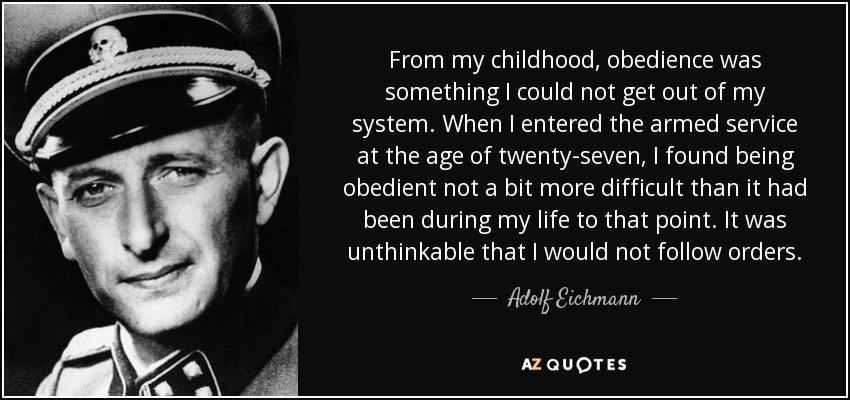
This at least, was the opinion of Hannah Arendt, writer, philosopher, and lens through which the English-speaking world most commonly views the Nazi war criminal. Writing in her 1963 publication, Eichmann in Jerusalem: a Report on the Banality of Evil, she documents how her protagonist, following his exile to Argentina and subsequent abduction at the hands of Mossad, was imprisoned, tried, and controversially executed by the state of Israel. The portrait she paints is chilling in its ordinariness. Far from the snarling psychotic or ideologically-possessed zealot many readers had hoped for, the man Arendt sees in the witness stand is little short of the archetypal nonentity. Balding and bespectacled, curiously bird-like between his Israeli guards, Eichmann submitted to his role within the Nazi’s machinery of murder, not out of some unbridled wickedness or warped moral convictions, but instead through the instinctive obedience and shallowness of thought that distinguishes the thoroughbred bureaucrat.
Admittedly, not everyone agrees with Arendt’s assessment of Eichmann. For that matter, not everyone agrees her assessment of evil. Upon its publication, Eichmann in Jerusalem was greeted with considerable backlash, not least among Arendt’s fellow Holocaust survivors, who accused the author of presenting the Jews as complicit in their own persecution, as well as showing undue sympathy toward her subject matter. It’s hard not to see their point. Horrors of the Holocaust aside, I have, throughout the course of my background reading, come across several statements by Eichmann which would seem to suggest that his enthusiasm for Hitler’s Final solution was rather more full-throated than Arendt (and certainly the defendant’s testimony), was willing to acknowledge. Nevertheless, whether or not Eichmann was merely the status-obsessed jobsworth the writer claims him to be, I think we can all recognize, in Arendt’s humdrum depiction, the kind of quintessential dullard who, given conducive circumstances, can become the unwitting executor of a quite inhuman evil.
And recently, it seems as though there has been a reemergence of these Little Eichmanns. Of course, it may sound harsh to compare petty enforcers of CDC diktats to the pencil pushers behind Soviet ‘de-Kulakization’, or to the administrators of the Khmer Rouge’s barbarous ineptitude. It would certainly be unwarranted to claim that today’s Covid-enabled tyranny has yet reached the depths of degradation endured beneath the boot-heel of those regimes. What it is less egregious to say, however – indeed, it is our civic duty to point out – is that even when the true motivations of Ardern, Macron, and others of their ilk became undeniable, still there remained, deep within their infrastructures of control, legions of underlings willing to carry out their duties with practiced amorality and unerring, Eichmann-like thoughtlessness.
Canada is perhaps the best example. Less than two years after kneeling in support of BLM and the largely fictional police brutality they torched cities in protest of, Prime Minister and noted blackface-enthusiast Justin Trudeau, ordered his jackboots to descend on protestors peacefully demanding freedom in Ottawa. Not content with this thuggery, he has since vowed to financially cripple them. True, it might be said that Castro the Lesser is merely enacting the will of Big Papa Schwab and the rest of his World Economic Forum cadre, but nevertheless, I hardly think it difficult to recognize in Trudeau’s heavy-handed panic, the same two motivations which have always preoccupied his parasitic political class: the retention and expansion of power.
What is more perplexing, however, is why these dipshits volunteer for the grunt work:
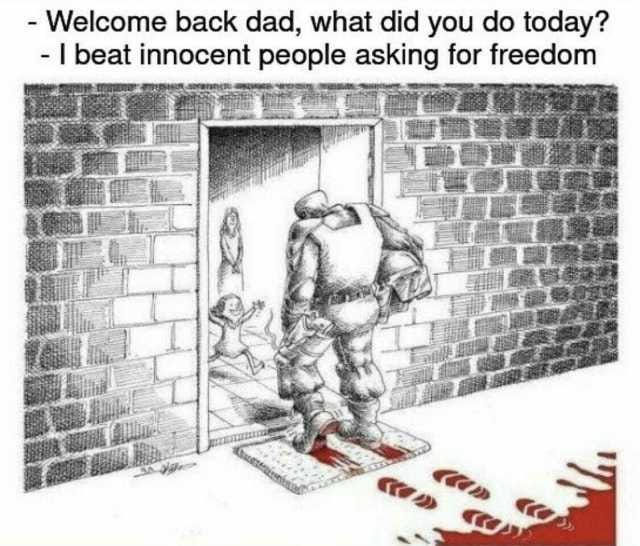
After watching the video above, I’m sure that many readers, as soon as they got their blood pressure stabilized, found themselves asking the same questions I did: What kind of men are behind those face masks and blacked-out goggles? How could anyone bring themselves to inflict such brazen injustice?
Of course, there is a part of me that wants to regard these officers as the embodiments of some demonic evil – an evil existing solely and exclusively for its own sake. This would not be without merit. A recent leaked group chat among the Royal Canadian Mounted Police proved they indeed have some profoundly shitty people within their ranks, and while these wrong’uns no doubt exist in far greater numbers than any of us would care to acknowledge, I nonetheless retain, a belief every bit as pessimistic, that it is regular ‘ole moral mediocrity and intellectual incuriousness, that makes most of these men so predisposed to lives of violent servility.
Please, do not mistake this for sympathy. If you were part of the goon squads sent in to rough up the convoy in Ottawa, or just as bad, one of the bank managers ordered to freeze the accounts of single mothers, let me say, with from-the-gut revulsion and the full agreement of untold millions, that you are nothing less than a traitor to humanity. Worse still, you know it. The same goes for government Brownshirts in France, Germany, and Australia, in India, Poland, and The Netherlands; the wrongness of your actions is evidenced by all the decent cops who’ve handed in their badges, and by the countless others too ashamed to look protestors in the eye. You have, in the face of this emerging technocratic super-evil, absolved yourself of personal responsibility by accepting as your highest moral code and highest form of conscious thought, the handed-down decrees of your superiors. And on the weekends? On weekends you let your fucking TV take over.
Don’t get me wrong: I can see the appeal. In a tale I’m sure a few readers can empathize with, I have spent much of the last two years – in my bluest of blue neighborhoods, in the most vaccinated of vaccinated towns – encountering only the occasional cameo of sanity. Sure, there were some days when the loneliness of the battle excited me. I would drive to the supermarket, get pumped as hell on the new Comeback Kid album, and then go about my maskless grocery shopping, returning the disapproving gaze of passing liberals with a smile and pleasant, hi and how’s your day been?
On others, it wasn’t so easy. During the very darkest of them, back when the narrative was at its most hysterical, there were times I could scarcely raise a smile at my wife let alone an indoctrinated stranger at the store. Hell, as much as it pains me to admit, there were even days, perhaps after seeing a mother muzzle her five year old or overhearing a conversation about the latest apocalypse variant, when I would have given damned near anything to believe it was nothing more than a paltry little pandemic that was tightening its grip upon our planet.
How much easier it would’ve been if the virus was what they said it was.
How soundly I would have slept, atop my frequently sanitized pillow, if only I had been able to accept the redemptive qualities of the jab and the infinite, benevolent wisdom of the experts.
Needless to say, in order to accept such manifest bullshit, I would have had to go against everything I could see with my eyes, not to mention everything I knew in my heart. But when you think about it, is that really so hard? All you have to do these days, in order to push down the worldview-obliterating suspicion that our every institution is corrupt, is to flick on your 64” entertainment system, power up your gaming console, and allow yourself to be swept out into an ocean of non-thought. Don’t worry, you won’t sound stupid at parties. You’ll get all the pre-approved opinions beamed straight to your cerebral cortex, and while this should sound like a fate worse than death, for those who have spent their career in service of these institutions, often plunging themselves into college debt slavery for the privilege, so too does it offer the opportunity to effortlessly ignore both the folly of their decisions and the bootlicking futility of their existence.
That is not to say that this is any less of an ethical or intellectual failing. After all, while I am not so unaccustomed to human frailty that I cannot appreciate where that first chink in the armor might occur, neither am so morally lobotomized that, upon orders from some Ken doll despot, I could ever bring myself to bludgeon an innocent protestor or to strip someone of their means of earning a living.

What I am saying, however, is that complacency is a trap. While it would be nice to conclude that evil lives elsewhere, in the minds of people much lesser than ourselves, the truth is that within each of us, deep down in the most pitiable part of our character, exists the curiously appealing notion that surrender is easier than the fight. Over the course of the last two years, we have witnessed the leaders of supposed liberal democracies stoke this idea through a barrage of fear, anxiety, hopelessness, and isolation, and while Covid may be receding as an excuse to use these weapons of mass enslavement, with Ukraine hotting up and a ratings-starved MSM eager to manufacture another crisis, it is surely only the most naïve among us who do not recognize that these techniques, now refined from experience, will again be used against us.
And when they do, the battle will begin anew. On the face of it, at least to those who have been paying attention, this will be simply the latest stage in the ongoing, arguably eternal, war between free man and those who would subjugate him. On this front, we have achieved two enormous victories. Not only have we resisted the most intensive and intricately planned psychological assault of all time, we have done so in such colossal numbers that we have pulled from behind the curtain, at least some the nebulous aristocracy who executed it. They are an ogreish and formidable bunch - rich beyond money, powerful beyond government, depraved beyond morality - and yet even they are not who we should truly fear.
Admittedly, our real enemy may appear less daunting. In fact, so nondescript is he, we often forget that he is there at all, itself a fiction we are happy to indulge. Previously, in the days before the Covid scam, we might have only encountered him at the DMV or in the guise of some middle management asshole. However, throughout the last twenty-something months, we’ve seen his specter rise up and take possession of doctors, civil servants, and perhaps most terrifyingly of all, cops. But make no mistake, whether or not you bowed to the bullshit, he’s inside you, too. Balding and bespectacled, pacing the prison cell of our subconscious, he is the most contemptible of all human truisms. He is the embodiment of the just-following-orders excuse, the pseudo-redemption of deliberate stupidity - the comforting, cowardly thoughtlessness of our own inner Eichmann.
Crypto Donations:
Bitcoin: 1MHzr38VAc3g5cucBGiT8axXkiamSAkEkZ
Ethereum: 0x9c79B04e56Ef1B85f148CaD9F4dBD4285b2f9E69