

On Substack, Selfhood, and the Fleeting Fiction Called "I"
"Consciousness is much more than the thorn, it is the dagger in the flesh." — Emil Cioran, Romanian-French philosopher and essayist (1911–1995)

One of the most famous and most oft-invoked dictums in all of philosophy is the Socratic claim, allegedly uttered at his trial for corrupting Athenian youth, that the unexamined life is not worth living.
This would seem difficult to dispute, not least on a platform as innately navel-gazing as Substack.
Certainly, as the animating principle behind many an essay within this uncommonly contemplative corner of the internet, your humble narrator’s very much included, self-reflection is heralded as the foremost precondition for all moral and intellectual seriousness: the means by which we might forge a virtuous character, reassert our cultural convictions, and by extension, arrest the decline of Western civilization.
But of course, Socrates’ world was one quite unrecognizable to our own. Unlike Ancient Greece, where an individual’s identity was born of blood, borders, and the inherited sureties of civic and religious life, ours is an age when ever-increasing numbers are filtering their self-conception through the lens of therapeutic psychobabble and pseudo-spiritual pieties, tailoring it to algorithmic affirmation and transient ideological trends. The result is a society in which the question of “who am I?” is asked so obsessively, but answered so performatively, that what it has yielded, far from the upstanding, ethically coherent human being Socrates envisioned, is a creature splintered into a pastiche of zealously guarded yet nakedly inauthentic personas.
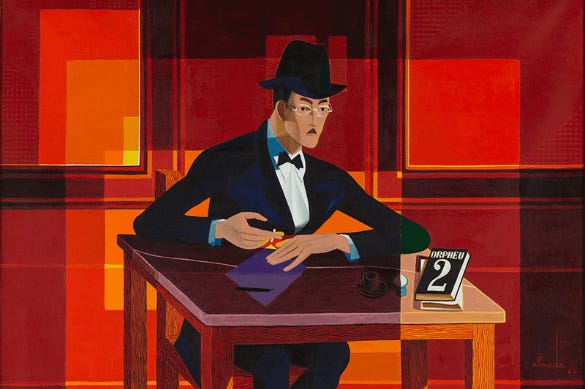
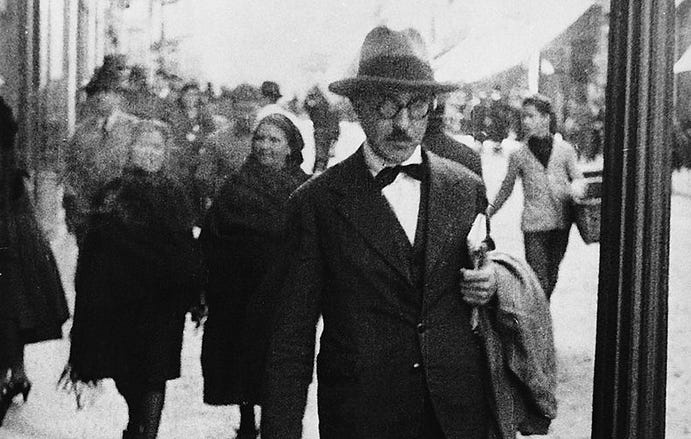
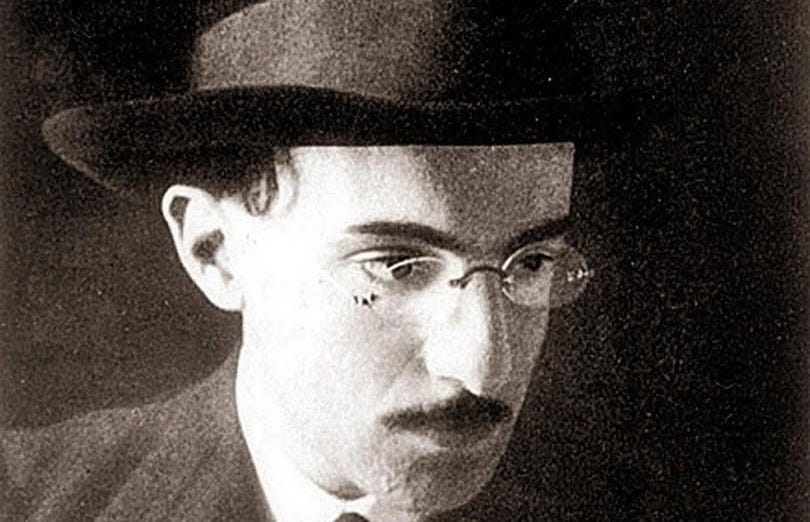
Fittingly, the man who best articulated this condition was one colonized by so many alter egos that he himself had all but dissolved into nonexistence. Slight of frame and stooped in posture, soberly dressed in a homburg hat and dark three-piece suit, this undistinguished bookkeeper ghosted through the cafés of interwar Lisbon in shadow-like anonymity, his round wire-rimmed spectacles and pencil moustache conspicuously reminiscent (insofar as anything about him could be described as conspicuous) of a cheap joke-shop disguise. He dined alone, drank alone, speaking with virtually no one outside his small circle of literary acquaintances. Although a compulsive and prodigiously prolific writer, he published, throughout his lifetime, little more than a few unacknowledged poetry collections as well as some scattered contributions to journals, while the various magazines he planned either never materialized or folded after a handful of issues. Indeed, when Fernando Pessoa died of alcohol-induced liver failure at the age of forty-seven, his passing was met with near wholesale indifference—the unremarkable end to an ostensibly unremarkable life.
Obscurity beckoned, and no doubt would have prevailed, were it not for the discovery, inside his rented room on the Rua Coelho da Rocha, of a nondescript wooden trunk. This contained over twenty-five thousand pages of poetry, prose, letters, and assorted metaphysical musings which, taken in their entirety, represented much more than the work of one man. Rather, what it constituted was an immense anthology of autonomous (if technically fictitious) authors whose vastly divergent visions and voices had been transcribed through a lone flesh-and-blood intermediary.
From the contents of that trunk was compiled Pessoa’s most celebrated masterpiece, The Book of Disquiet—a manuscript that was never finished, never arranged, and not published until almost half a century after his death. It resists all attempts at classification. Part diary, part prose poetry, and part philosophical meditation, it consists of five hundred loosely connected vignettes touching on everything from the tedium of office life to the superiority of dreams over lived experience, from writing as a form of self-erasure to the protagonist’s mournful meanderings through twilit streets. The sole unifying feature of this “factless autobiography,” beyond its febrile musicality, is the nebulous purgatory of being alive without quite living, of observing reality through the eyes of a detached, chronically melancholic voyeur.
It was a melancholy which had suffused Pessoa since childhood. His father, Joaquim, a music critic of converso Jewish ancestry, died of tuberculosis when Fernando was just five years old, his baby brother Jorge following scarcely six months later. These compounding tragedies were but the latest to play out in a household already haunted by his grandmother’s episodic insanity, and yet, within just weeks, Pessoa’s mother Maria Madalena was swept into what biographer Richard Zenith calls a state of “mild euphoria,” having become besotted with João Miguel Rosa, a former naval officer turned diplomat. The pair married not long after, Fernando’s newly reconfigured family (which now included five much younger half-siblings) emigrating to the British colonial port of Durban, South Africa, where his reluctantly accepted stepfather had been appointed Portuguese consul.
It was here, amid this steadily mounting discontinuity, that the bright but frequently withdrawn child further refined his talent for conjuring literary companionship. He had previously begun this practice with the creation of Chevalier de Pas, an imaginary French knight with whom the then-six-year-old had engaged in ongoing letter correspondence. Immersed in an English-speaking environment, however, these parallel selves became progressively more elaborate and even multilingual—Pessoa channeling the spirits of “Alexander Search” and “Charles Robert Anon,” alongside a rotating cast of “journalists” who staffed the homemade newspapers he assembled as a teenager.
On his return to Lisbon in 1905, the habit had become so entrenched that it was practically inseparable from the act of writing itself, the rapidly maturing artist going so far as to coin his own term: heteronyms.
Endowed with their own biographies in addition to distinct (often conflicting) philosophies and literary styles, these were as labyrinthine as any living person. Among the most noteworthy were Álvaro de Campos, a rakish naval engineer who travelled the world penning rhapsodic, Whitmanesque verse, as well as Ricardo Reis, a Jesuit-educated physician and Hellenist whose Horace-inspired compositions espoused discipline and stoic acceptance of fate. Above these stood Pessoa’s so-called “master” heteronym, Alberto Caeiro. An “untutored child of nature” who declared “thinking is to have a disease of the eyes,” this plainspoken shepherd-poet is said to have arrived fully formed in a single afternoon of frenzied inspiration, though it is arguably Bernardo Soares, as The Book of Disquiet’s attributed author, who has proved best remembered. An assistant bookkeeper paralyzed by anxiety and crippling introspection, Soares was not wholly self-contained in the manner of Pessoa’s other emanations but functioned instead as a “semi-heteronym” whose sentiments are regularly cited as a rare insight into his originator’s own.
Among literary scholars and his still-growing legion of admirers, this sprawling cast of collaborators, disembodied yet intimately tangible, is regarded as both evidence for and an expression of Pessoa’s inimitable genius. Such tributes are hardly misplaced. But while writers such as Goethe and Dostoyevsky, Tolstoy and Proust, may have dredged the depths of the human psyche in the hope of returning with truths universal, The Book of Disquiet chronicles the desolation of a man who refused to claw his way back up.
For Pessoa, engaging in self-examination was to be confronted with the catastrophically destabilizing realization that there was no substantial self to be examined, merely a series of thoughts and sensations coalesced into the fleeting fiction dubbed “I.” His heteronyms were his answer to this impasse. If one’s personhood was in fact illusory—the external world nothing more than a consensual, coherence-enabling delusion—he would multiply the illusion indefinitely, adopting the irreconcilable perspectives of Caeiro, Reis, Campos, and dozens of other surrogate selves in order to map the full range of conscious experience. This was at once his greatest achievement and the root of his psychological unravelling. In the process of demonstrating that no one person could ever capture, much less comprehend, the totality of existence, so too did he relinquish his own place within it, his essence lost in a sea of infinite others. As he reveals in The Book of Disquiet:
“I’ve created various personalities within. I constantly create personalities. Each of my dreams, as soon as I start dreaming it, is immediately incarnated in another person, who is then the one dreaming it, and not I. To create, I’ve destroyed myself. I’ve so externalized myself on the inside that I don’t exist there except externally. I’m the empty stage where various actors act out various plays.”
A century later, this same fragmentation has calcified into a near-ubiquitous lifestyle, albeit one bereft of any redeeming literary merit. After all, the modern individual maintains, as a matter of routine, a plurality of selves that rival, in number if not in complexity, the seventy-odd heteronyms channeled by Pessoa. At its most transparent, this manifests as the carefully curated professionalism presented on LinkedIn or the duck-pouting desirability offered up on Tinder; the aspirational image projected onto Instagram or the quick-witted cultural commentary broadcast across X. Nevertheless, neither should we deny, whether in ourselves or others, the pseudo-intellectual posturing which proliferates across Substack—self-expression elevated to the digital age’s most sacred value, all while producing selves with ever less substance to express.
Modern life has also become every bit as spectatorial as Pessoa’s. Written metaphorically (if not always literally) from his fourth-floor window above the Rua dos Douradores, the author annotates his impressions of the street beneath, transforming its people and their petty melodramas into prose of exquisite sensitivity, even as he steadfastly declines to participate. His loneliness is palpable, his exile absolute, but still he consoles himself with the notion, reflexively and somewhat disdainfully, that “…for superior men, life should be a dream that spurns confrontations. Direct experience is an evasion, or hiding place, for those without any imagination.”
But however solipsistic such reasoning might seem, it is functionally identical to the justifications which many of us make daily. Where Pessoa had his notebook and fourth-floor vantage point, the contemporary onlooker has his screen and through it, an ever-open portal into other people’s lives—scrolling through moments he will never inhabit, consuming news he will never act upon, and cultivating outrage he will never convert into meaningful resolve. This grants much the same relief sought by Pessoa, insulating oneself from the demands of human connection, while simultaneously cementing the despondency of one who has exempted himself from its solaces too. As he himself concedes:
“Solitude devastates me; company oppresses me. The presence of another person derails my thoughts; I dream of the other’s presence with a strange absent-mindedness that no amount of my analytical scrutiny can define.”

Today, Pessoa’s reputation continues to grow. In his native Portugal, the poet has long been enshrined with near-mythic status, statues erected in his honor, museums dedicated to his work, yet it is only now, as ever more translations emerge, that he is at last receiving global recognition.
This is perhaps the most Pessoan irony of all.
His is a legacy, it must be said, which endures chiefly as an editorial approximation, each successive publication providing a radically different interpretation of his corpus. These have been further repurposed by philosophers who laud his insights into consciousness while overlooking his sincere belief in the occult, by transgender activists who embrace his arguments for fluid identity while ignoring his ardent imperialism, as well as traditionalists who champion his mystical nationalism while omitting his defense of both freemasonry and gay literature—the real Pessoa remaining, as much in death as in life, an elusive and eternally malleable figure.
That is not to imply that his worldview is without its critics. These typically focus on the nihilism lurking just beneath its surface alongside the impossibility of moral accountability in the absence of a stable self, but ultimately the most devastating refutation of Pessoa’s outlook may not be any abstract objection but rather the unenviable particulars of his obituary.
Although his body now lies beside those of Vasco da Gama, Luís de Camões, and other Portuguese luminaries in the Jerónimos Monastery, Pessoa was not reinterred there until 1985, some fifty years after his death. His original resting place, by contrast, was a considerably more modest affair, his funeral attended only by his sister, a thin smattering of fellow poets, and a woman by the name of Ophelia Queiroz; the sole romance of the writer’s life abandoned after a single kiss. It was an apt farewell for a man who had long ago perfected the art of disappearing, to say nothing of its grim forewarning for those who have inherited his condition. Because if Socrates was right that the unexamined life is not worth living, then the case of Fernando Pessoa—and with it, the cases of millions who have today fractured themselves into a confusion of avatars and algorithmic alter egos—suggests that a life consumed by self-examination will, in the end, prove no less unlivable.
Thanks ever so much for reading. Given that you’ve made it this far, please consider giving this article a like, share, or better yet, a comment—I really can’t tell you how much that helps. If, on the other hand, you’d like to support my work (and are in a position to do so), I would be indescribably grateful if you might consider becoming a paid subscriber, while alternatively, you can always send a one-time donation via the link below. As I’m sure you can appreciate, piecing together essays of this scope necessitates a substantial amount of time and effort, and every contribution goes a long way in helping me produce others like it.
Thanks again for your time,
Carson

Some Recent Articles You Might Like:
Bruce Springsteen: The Poet Laureate of Boomer Pathology

In a year already rich with tragedies—from the bombing of 120 Iranian schoolgirls to the systematic memory-holing of Iryna Zarutska, from Europe’s epidemic of migrant-inflicted savagery to the state-sanctioned murder of Noelia Castillo—Bruce Springsteen’s performance at the recent No Kings...
On Mental Illness and the Therapeutic Erasure of Evil

“The older I get,” wrote Dudley Newright recently, his note accompanied by the video above, “the more convinced I am that the line between ‘mental illness’ and ‘evil’ is blurry and, in some (not all) cases, ‘mental illness’ is simply what happens when a person who wants to ‘be bad’ gives themself...
Feminizing the Machine

The sudden ubiquity of artificial intelligence has given rise to fears ranging from the luridly apocalyptic to the sober, serious, and well-founded. Many warn of unprecedented economic upheaval, with entire industries swept away by machines capable of operating at superhuman efficiency. Some worry...
Which translation do you recommend?
It is essays like this that remind me how little I know about anything, but I am more saddened for the likes of Pessoa than encouraged by his mistaken insight. I perceive that the problem with "I" is the I. When we look at the world we can be self absorbed or open eyed with wonder. In religious circles they say that God is continually "self revealing", but again the problem is that we have to be searching for God in order for him to be seen. For me it is easy to see God in his creation, especially in his masterpiece of humanity from the most simple to the most exemplary, for I already know that like myself we are unable to be perfected, except by Him. Pessoa was searching for answers within himself and there are none, for God made us to be lovers of others, which is how love grows - infinitely. Why settle for less when the abundance is there for the taking, with the overwhelming assistance from the very source of Love, which is God.