


Edward Bernays - The Man Who Conquered the Normie Mind (Part One)
Reaching blue-pilled friends and family can feel impossible, yet by relying solely on logic, we neglect the far stronger emotional bonds which keep them wedded to the official narrative.

It was a scene played out innumerable times across the country: a mother clearing away the remnants of the turkey as her husband curses the football players on his TV screen. An elderly relative doses in their armchair. A couple of little ones squabble over their new toys amid a carpet of discarded wrapping paper. Perhaps some jackass uncle insists on playing his selection of Christmas hits, while the black sheep of the family – that would be you, dear reader – remains in their neglected corner, speaking only to confirm they want a drinks refill or to forlornly reiterate the absurdity of the most recent CDC guidelines.

Of course, this kind of familial friction is hardly limited to Christmas, nor even to Covid. Over the course of the last ten years, visits home for Thanksgiving or to celebrate Independence Day have all too often been accompanied by the discovery that another college-aged cousin has succumbed to leftist indoctrination, or that a once favorite aunt is trying out gender-neutral parenting, and so, hoping to steel myself for the upcoming merriment, I spent the days leading up to it re-watching The Century of the Self, a 2002 British documentary by Adam Curtis.
Now, under most circumstances, I would never watch, much less recommend, anything by the BBC. It’s not just the fact they are an establishment mouthpiece. Neither is it their abysmal journalistic practices. Hell, even if it wasn’t for their decades of institutionalized pedophilia, I’d still avoid them purely on the basis they used to employ John fucking Sweeney, however, on this occasion, I feel The Century of the Self merits an exception.
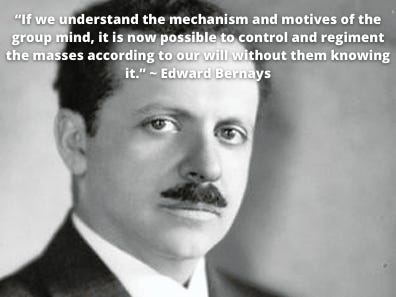
Focusing on the work of Edward Bernays, an American business consultant and nephew of Sigmund Freud, the film shows how “The Father of Public Relations” used his more famous uncle’s theories to help corporations and ultimately governments direct the will of the population by tapping into their deepest, most unconscious desires.
And let me tell you, in 2021, the implications are nothing short of seismic.
The first episode in the four episode series is entitled “Happiness Machines”, a term which comes from a 1928 address by President Hoover to a group of publicists and advertisers.
“You have taken over the job of creating desire and have transformed people into constantly moving happiness machines, machines which have become the key to economic progress…. By advertising and other promotional devices…we have a boundless field before us; that there are new wants which will make way endlessly for newer wants, as fast as they are satisfied.”
This statement is a remarkable one for Bernays, not least in that he was arguably the most influential figure in industry. Cynical about human nature and resoundingly dismissive of the capacity of the masses to rationally govern themselves, Hoover’s statement would no doubt have been music to the ears of a ruthlessly ambitious Bernays and yet, it is much earlier, back when when he was working in the comparatively modest and entirely apolitical role of a press agent, that The Century of the Self chooses to pick up his story.
In 1917, America’s long-awaited involvement in World War One presented the young Bernays with an opportunity. Woodrow Wilson’s decision to join the conflict came after strident promises to the contrary had secured him reelection, but nevertheless, with German victory looking increasingly possible, the president was, just five months after returning to office, forced into a change of heart.

In an effort to persuade the American public of the necessity of war, President Wilson established the the Committee for Public Information. Although a twenty-six year-old Bernays enjoyed only a junior role, he was clearly impacted by how quickly and how thoroughly the organization was able to convince a once reluctant public to throw themselves behind the Allied cause, and soon after Germany’s surrender and the ensuing Paris Peace Conference, he returned to New York, confident that the same techniques could be applied within the commercial sphere.
To do this, he turned to the help of his Uncle Sigmund. Up until this point, advertising had been a fairly unimaginative affair in which products were marketed, quite naturally, on basis of their practical benefits. A car, for example, would be presented in terms of comfort or miles per gallon, toothpaste with regard to taste and cleaning potential. Bernays’s great realization was that these rational considerations constitute only a small fraction of what truly drives human decision-making, and by tapping into Freud’s ideas of the Unconscious – that great uncharted reservoir of repressed, animalistic, and often destructive urges – he discovered that it was much more lucrative to sell not commodities, but rather the customer’s image of themselves as the owner of that commodity.
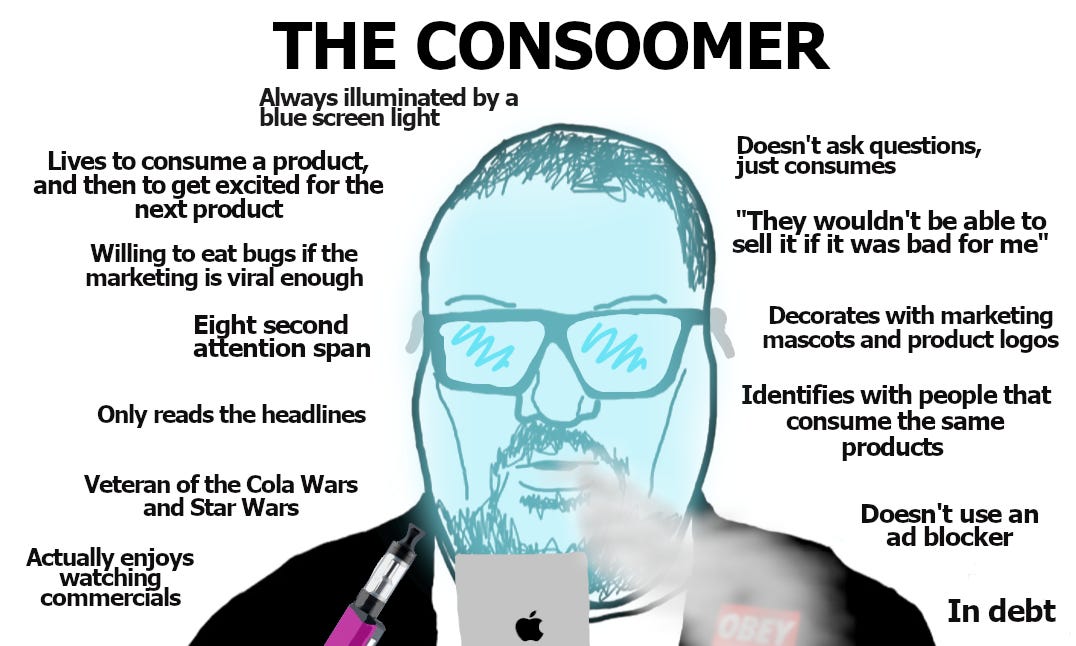
His ploy was masterful. Scarcely had Bernays’s approach been adopted than it revolutionized the way in which corporations interacted with the public, and soon its inventor was sought by the leaders of Big Tobacco with the view to doubling their customer base.
Specifically, they wanted women to smoke.
You see, back in the Roaring Twenties, there existed a deeply entrenched taboo against the practice, but yet after only a little psychoanalytical excavation work, Bernays devised a plan. Hiring a bunch of rich debutantes to pose as suffragettes in New York’s Easter Parade, he instructed them, at a designated moment, to triumphantly light up their cigarettes. This was to be done in front of a group of reporters whom Bernays had already notified of this “protest”, and sure enough, the very next day, images of these fashionable, defiantly puffing young ladies were displayed in magazines and newspapers across the country, Bernays on hand to supply the tag line – “Torches of Freedom.”
By tying cigarettes to this burgeoning new social movement, Bernays not only created a potent and suddenly desirable symbol of female empowerment, but also demonstrated to corporate American how it was possible to create and obliterate social norms almost at will.

It was in Walter Lippmann, arguably the most prominent journalist of the era, that Bernays found (or at least, claimed to have found) his closest political ally. Lippmann contented that if the public could not indeed be trusted to arrive at a rational, evidence-based conclusion then reality therefore demanded the creation of a new, enlightened class of elites who could steer democracy and “the bewildered herd” away from calamity. This was a philosophy of government that Bernays had advocated for some time, but now, for the first time, he found that he was was beginning to be joined by a chorus of other highly consequential voices.
Loudest among them was Herbert Hoover. It was the view of his administration that consumerism now represented the central pillar of American society, a society in which advertisers and publicists enjoyed roles of unprecedented importance. It was men such as Bernays, he claimed, on whom the nation’s continued peace and prosperity depended – a position made all the more extraordinary by the fact that they created neither. Instead, by first stimulating the citizenry’s innermost desires and then promptly providing the product or policy to satisfy them, Bernays and his peers were responsible for fueling both the rabid materialism of America’s economic boom as well as an atmosphere of commodity-based contentedness in which politicians could go about the business of government, largely untroubled by an electorate they had rendered happy, docile, and incurious.

Watching The Century of the Self in 2021, there are many such moments which seem almost jarringly prescient. Perhaps this is a core components of all great documentaries. Perhaps a more keen and inquiring mind than my own would have appreciated the magnitude of the film’s message back when I first watched the movie a decade ago, and yet, in an age of near constant Covid delirium and the relentless push of the “vaccines”, it is difficult not recognize, both in our leaders and fellow citizens, echoes of Bernays’s strange and terrible work.
If you are interested in checking out the rest of The Century of the Self, you can do so right here, while if you prefer, you can always hit the subscribe button below and I’ll be sure to send Part Two of my analysis (along with loads of other great stuff) straight to your inbox.
Crypto Donations:
Bitcoin: 1MHzr38VAc3g5cucBGiT8axXkiamSAkEkZ
Ethereum: 0x9c79B04e56Ef1B85f148CaD9F4dBD4285b2f9E69